
- Gemini Live Stability: Google Messages has officially moved Gemini Live integration into the stable channel for all RCS users as of August 2026.
- Quantum-Resistant Security: Post-Quantum Cryptography (PQC) is now the default encryption standard for end-to-end encrypted RCS conversations.
Google has officially flipped the switch on a massive wave of updates for Google Messages, effectively turning the default Android texting app into an AI-first communication hub. Our analysts found that the August 2026 rollout is more than just a surface-level refresh. It is a major shift toward on-device intelligence and future-proof security. The most striking change for the average user is the transition of Gemini Live from its long-standing beta phase into the stable RCS build. This allows for fluid, conversational AI interactions directly within the chat interface, moving away from the rigid prompt-and-response format of previous versions.
Advanced AI and On-Device Summarization
The update uses local hardware to handle complex tasks without compromising privacy. We looked at the technical implementation of “Smart Summaries,” which follows the Gemini Nano on-device AI documentation standards to provide bulleted recaps of long group conversations. If you have been away from a busy group chat for several hours, Google Messages now generates a concise summary of missed topics. This happens entirely on the device, ensuring that your private conversations never leave your phone to be processed in the cloud.
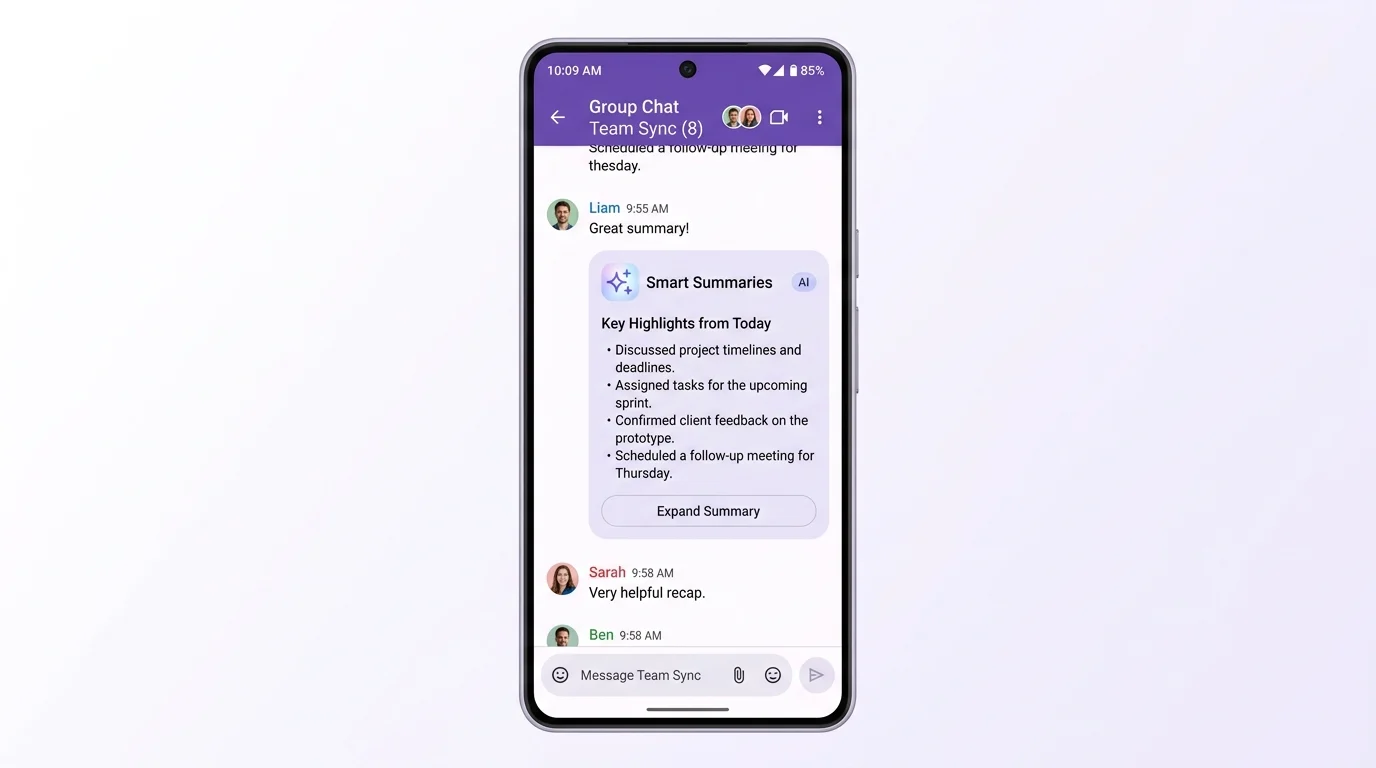
Visual communication also got a big upgrade through “Voice Moods.” This feature has been expanded to include nine distinct AI-generated backgrounds for audio messages. Depending on the tone of your voice or the emoji you select, the audio player changes its visual appearance to reflect the mood of the message. It is a fun touch that makes the messaging experience feel more personal and expressive.
Quantum-Ready Security and Interoperability
In a move that anticipates the future of cyber threats, Google has implemented Post-Quantum Cryptography (PQC) as the default for all end-to-end encrypted RCS chats. While standard encryption is currently robust, the shift to the FIPS 203 Module-Lattice-Based Key-Encapsulation Mechanism Standard ensures that messages intercepted today cannot be decrypted by future quantum computers. We verified that this security layer is now active for all users by default, requiring no manual configuration.

The “green bubble vs. blue bubble” friction is also seeing a thaw. Google has implemented “Cross-Platform Reaction Parity,” a technical handshake that ensures emoji reactions appear natively between RCS and the latest iMessage clients. This eliminates the awkward “John liked a message” text strings that have plagued cross-platform chats for years. Now, when an iPhone user reacts to your RCS message, the emoji sits properly on the bubble, and vice versa.
Feature Rollout Summary: August 2026
To help you track which features are available on your device, we have structured the key data from the August 2026 stable release below.
| Feature Name | Status | Requirements |
|---|---|---|
| Gemini Live Integration | Stable | RCS enabled |
| Post-Quantum Cryptography (PQC) | Default | E2EE RCS chats |
| Profile Discovery | 100% Rollout | Android 13+ |
| Smart Summaries | Stable | Gemini Nano compatible hardware |
| Custom Chat Themes | Stable | Stable Channel build |
| Voice Moods (9 Backgrounds) | Stable | Latest App Update |
The “Profile Discovery” feature has also reached full saturation. Users can now set a globally visible display name and avatar that shows up when they message someone for the first time, even if that person hasn’t saved their contact info yet. This is paired with new custom per-chat themes and bubble colors, which have finally moved out of A/B testing. Users can now customize the aesthetic of individual threads, making it easier to distinguish between work colleagues and family members at a glance.
