
The tech industry is witnessing a rare hardware reversal as high memory prices force leading chipmakers to revive older platforms. On October 9, 2026, Gigabyte released BIOS updates for its B760 and H610 motherboards, officially extending support to upcoming Intel processors on the LGA 1700 socket. The move confirms that despite Intel’s recent transition to the LGA 1851 platform for high-end chips, the company is returning to its previous-generation socket to leverage more affordable DDR4 memory.
The primary driver for this shift is a global surge in memory costs, often referred to as the “RAMpocalypse.” In late 2026, 32GB kits of DDR5 memory have reached prices exceeding $480. While DDR4 is a decade-old standard, the significant price gap has made DDR5-only systems prohibitively expensive for budget and mid-range consumers.
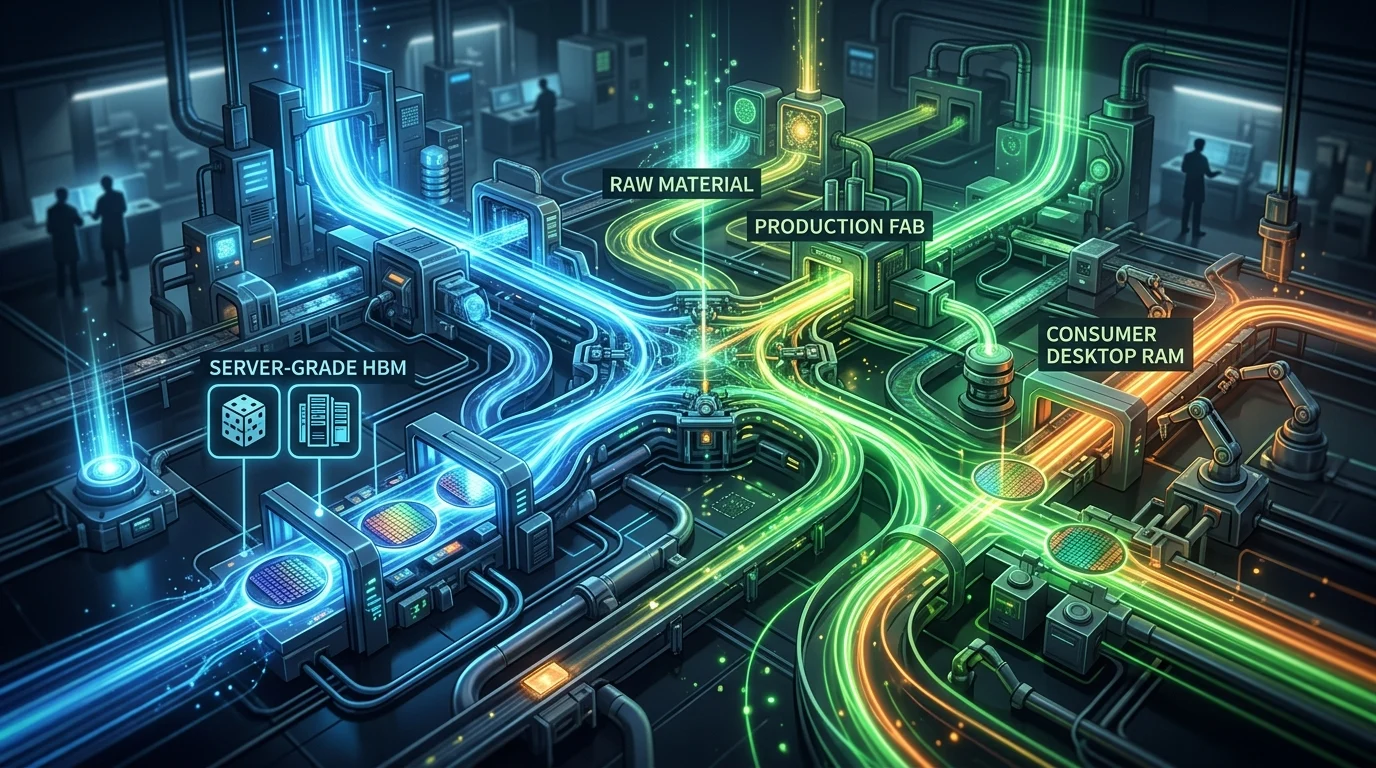
This pricing crisis stems from the explosive growth of the AI sector. Semiconductor manufacturers have shifted significant production capacity toward High Bandwidth Memory (HBM) and specialized server DRAM to meet the demands of AI data centers. This pivot has cannibalized the production lines normally reserved for consumer-grade DDR5, leading to severe shortages and the current price spikes.
The Return of Raptor Lake
The upcoming processors supported by the new Gigabyte BIOS are expected to launch in early 2027. Reported under the branding “Raptor Lake Next” or the “Core 2000” series, these chips are essentially a refreshed version of existing architecture designed to fit the older LGA 1700 socket. This allows users to build modern systems using motherboards and DDR4 RAM that are significantly cheaper than current-generation alternatives.
Intel’s Robert Hallock previously stated that LGA 1700 would remain a core part of the company’s portfolio for “years to come,” citing continued interest in DDR4 compatibility. While Gigabyte’s recent BIOS updates cover the B760 and H610 lines, notably missing from the announcement were high-end Z790 motherboards, suggesting that this “revival” is targeted strictly at the value-conscious segment of the market.
AMD’s Parallel Strategy
Intel is not alone in looking backward to find a path forward. In September 2026, AMD released the Ryzen 5 5500F, a $99 processor designed for the aging AM4 platform. Like Intel’s LGA 1700, the AM4 platform relies on DDR4 memory, providing a low-cost entry point for gamers and office users who cannot justify the $480 price tag of a DDR5 memory kit.
By maintaining these older platforms, manufacturers are effectively creating a two-tier market: a high-performance, high-cost tier utilizing DDR5 and the newer LGA 1851 or AM5 sockets, and a “legacy” tier that provides modern processing power through DDR4-compatible hardware. For consumers building a PC in late 2026, the choice between these tiers has become a matter of spending hundreds of dollars more for memory that, in many real-world applications, offers only marginal performance gains over the decade-old standard.
