
The best TVs of 2026 are no longer separated by one simple question such as OLED versus LCD. Premium OLEDs are brighter and more glare-resistant, Mini-LED sets are pushing harder on black level and color volume, and RGB-based backlights have become a serious new option for buyers who want extreme brightness without giving up color saturation. After comparing the current 2026 field, our top overall choice is the Samsung S95H OLED, while the LG G6, Sony BRAVIA 9 II, TCL QM8L and LG C6 each make stronger sense for particular rooms, budgets or viewing priorities.
Updated October 12, 2026: We rechecked model identities and expanded the comparison from eight to ten genuine 2026 TVs. The original September 12 price observations below are historical snapshots, not today’s guaranteed offers. For example, the 65-inch Hisense UR9 (65UR9SG) was observed at Best Buy on September 12 for $1,699.99, below a $2,199.99 comparable value. Retail pricing changes frequently, so treat every price in this guide as a snapshot rather than a permanent street price.
Our 10 TV picks
Samsung S95H OLED
AsumeTech score: 9.3/10
Our strongest all-around 2026 TV for buyers who want OLED black levels, unusually strong brightness and glare handling, plus high-refresh gaming capability.
Best for: Premium mixed use, gaming and bright living rooms.
Pros: Excellent contrast; very bright for OLED; strong reflection control; up to 165Hz gaming support.
Cons: Premium pricing; buyers committed to Dolby Vision should note Samsung’s HDR format strategy.
LG OLED evo G6
AsumeTech score: 9.1/10
A premium OLED built for buyers who prioritize cinematic contrast, HDR flexibility and LG’s mature enthusiast feature set.
Best for: Movie-first home theaters and premium OLED buyers.
Pros: Excellent OLED contrast; strong HDR performance; broad gaming support.
Cons: Expensive; value depends heavily on street pricing versus the C6 and S95H.
LG OLED evo C6
AsumeTech score: 8.9/10
The C6 remains the sensible OLED choice for buyers who want much of LG’s premium experience without automatically stepping up to the G-series.
Best for: Balanced movies, streaming and gaming.
Pros: Strong picture quality; mature smart platform; meaningful processing and brightness gains over its predecessor.
Cons: Current 65-inch pricing can sit uncomfortably close to discounted premium models.
Sony BRAVIA 9 II True RGB
AsumeTech score: 9.0/10
Sony’s premium RGB-backlit flagship is the specialist choice when daylight performance, HDR impact and color volume matter more than OLED-thin design.
Best for: Bright rooms, premium HDR and daytime sports.
Pros: Very high brightness; excellent anti-reflection behavior; deep blacks for a backlit display.
Cons: High price; OLED remains cleaner around some difficult high-contrast objects.
Sony BRAVIA 6 OLED
AsumeTech score: 8.6/10
A more attainable route into Sony’s OLED lineup, with the brand’s picture-processing emphasis at a lower price than its flagship displays.
Best for: Sony fans, movies and mixed streaming.
Pros: OLED contrast; Sony processing; broad size range.
Cons: Less compelling for pure value hunters than aggressive TCL pricing; not the brightness leader.
TCL QM8L SQD-Mini LED
AsumeTech score: 8.8/10
The QM8L is where flagship-like brightness and convincing local dimming meet much more aggressive street pricing.
Best for: Bright-room value, sports and large-screen buyers.
Pros: High brightness; strong black levels for Mini-LED; limited blooming in favorable material; aggressive pricing.
Cons: OLED still has the edge in pixel-level contrast consistency; processing is not the main reason to choose it.
Hisense UR9 RGB MiniLED
AsumeTech score: 8.4/10
The UR9 brings second-generation RGB MiniLED into a much more accessible price bracket, but its current tradeoffs keep it from being our default flagship recommendation.
Best for: Buyers curious about RGB MiniLED and high-impact HDR.
Pros: Strong brightness and color potential; broad 65- to 100-inch range; compelling observed 65-inch price.
Cons: Independent testing has raised color-balance and gaming-latency concerns; not as universally polished as our top picks.
TCL QM7L SQD-Mini LED
AsumeTech score: 8.5/10
The QM7L makes the strongest case for shoppers who want a modern 144Hz Mini-LED TV without moving into premium-TV pricing.
Best for: Value-conscious gaming, streaming and bright rooms.
Pros: 144Hz panel; Mini-LED contrast control; aggressive 65-inch sale pricing.
Cons: Gives up some premium brightness, refinement and processing versus the more expensive leaders.
LG OLED B6 (2026)
AsumeTech score: 8.7/10
The least expensive OLED in our shortlist when discounted, with excellent out-of-box accuracy and console gaming support.
Best for: Movie fans in dim rooms, first-time OLED buyers and console gamers.
Pros: Self-lit black levels; Dolby Vision; four HDMI 2.1 ports; 120Hz gaming; accurate picture without extensive setup.
Cons: Noticeably dimmer than the C6; limited glare control in bright rooms; 120Hz cap for PC gamers.
Sony BRAVIA 7 II True RGB (2026)
AsumeTech score: 8.8/10
A less expensive entry to Sony’s RGB Mini-LED picture processing than the flagship BRAVIA 9 II, with bright HDR and Dolby Vision support.
Best for: Movie watchers who want Sony processing and vivid RGB color without flagship pricing.
Pros: Strong HDR brightness and contrast; very good upscaling; wide HDR format support; 50- to 98-inch family.
Cons: Mediocre direct reflection control; only two full-bandwidth HDMI 2.1 ports; fast gaming motion can blur.
Best TVs of 2026 compared
| Product | Display approach | Best for | 65-inch price context | Score |
|---|---|---|---|---|
| Samsung S95H | OLED | Best overall | About $3,399 official listed price when checked | 9.3 |
| LG G6 | OLED evo | Premium movies | About $2,799 observed LG price; $3,399 launch MSRP | 9.1 |
| LG C6 | OLED evo | Mainstream OLED | About $2,699 official price | 8.9 |
| Sony BRAVIA 9 II | True RGB backlight | Bright rooms | About $3,599 official price | 9.0 |
| Sony BRAVIA 6 OLED | OLED | Sony OLED value | About $1,999 official price | 8.6 |
| TCL QM8L | SQD-Mini LED | Mini-LED value | About $1,399 observed TCL sale; $2,499 MSRP | 8.8 |
| Hisense UR9 | RGB MiniLED | RGB MiniLED alternative | $1,699.99 observed at Best Buy; $2,199.99 comparable value | 8.4 |
| TCL QM7L | SQD-Mini LED | Budget performance | About $899 observed TCL sale; $1,499 MSRP | 8.5 |
| LG B6 (2026) | OLED | Affordable dark-room OLED | $1,399.99 on LG’s U.S. 65-inch page checked Oct. 12; promotional | 8.7 |
| Sony BRAVIA 7 II | True RGB Mini-LED | Mid-priced Sony RGB | $1,799.99 sale / $2,599.99 regular on Sony U.S. page checked Oct. 12 | 8.8 |
How we evaluated these TVs
We researched current manufacturer specifications, model-year information and supported features, then compared those claims with established independent testing where measurements were available. We did not physically test these televisions. Our ten models each have a unique P-ID (P001–P010). Their scores are research-based editorial suitability judgments, not measured lab ratings; differences of one or two tenths should not override your room or budget. Our TV scoring profile weights picture quality at 24%, HDR at 13%, motion at 10%, gaming at 11%, smart platform at 8%, sound at 7%, design and connectivity at 9%, and value at 18%. Where a criterion lacked enough dependable evidence, we did not let an unsupported assumption drive the recommendation.
Price matters heavily because the best television at a $3,500 launch price can become a very different recommendation at $2,500, while a strong $1,500 Mini-LED can become exceptional at $900. We therefore distinguish official pricing, MSRP and observed sale pricing rather than pretending a single number is permanent.
Samsung S95H OLED: Best Overall
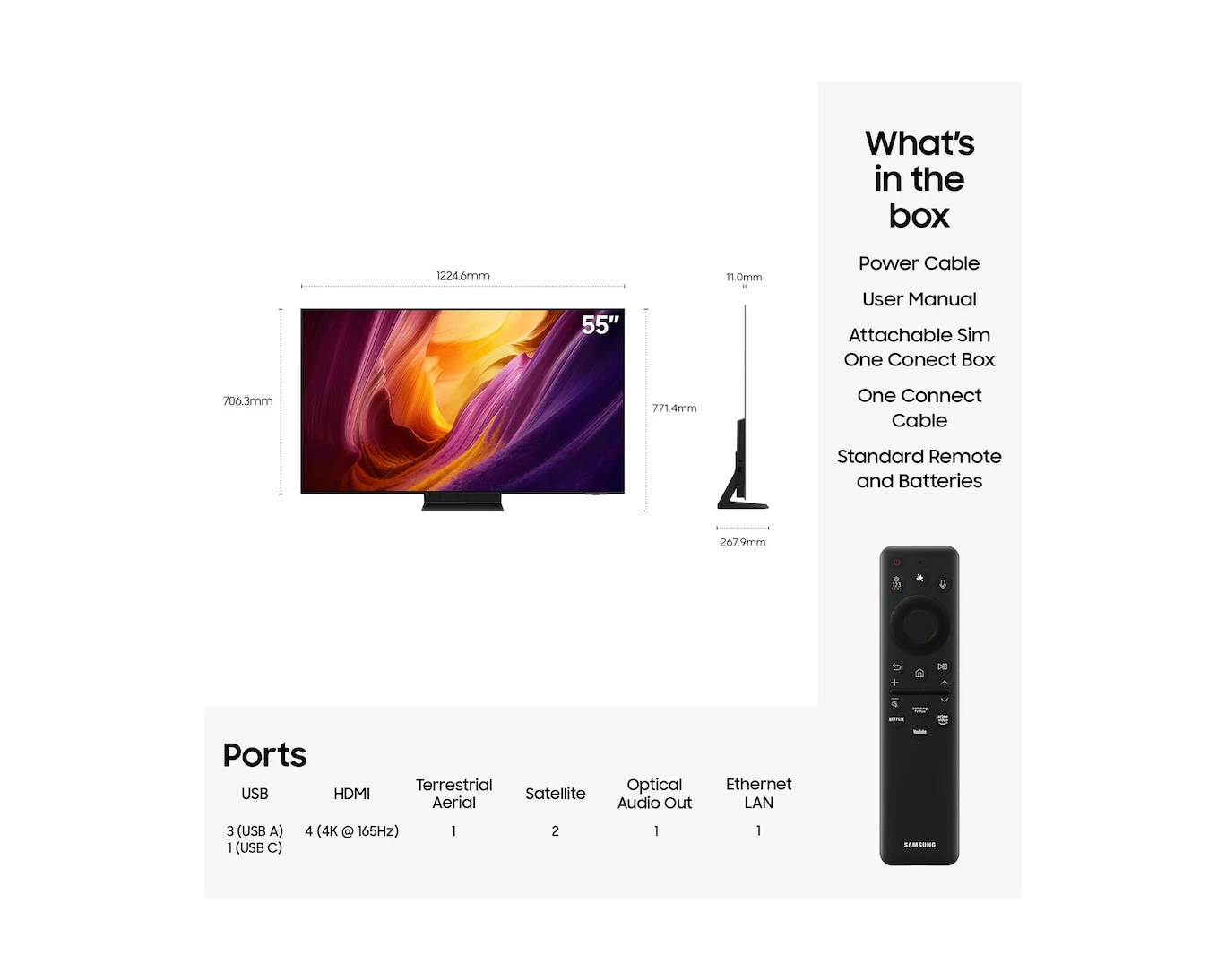
The Samsung S95H is our Best Overall TV of 2026 because it combines the qualities that traditionally make OLED desirable with improvements aimed directly at OLED’s historical weaknesses. You still get self-emissive contrast, where dark pixels can switch off instead of relying on a backlight, but Samsung also pushes brightness and reflection handling hard enough that this is no longer a TV we would reserve only for a controlled dark room.
Samsung specifies its NQ4 AI Gen3 processor, OLED HDR Pro and gaming support up to 165Hz. Those features matter in combination: high refresh support is useful to PC gamers only if the panel response and processing remain responsive, while extra OLED brightness matters only if the TV can preserve convincing contrast and color in real content. Independent evaluation of the S95H has been particularly positive about its brightness and glare handling, which strengthens its case as a premium mixed-room television rather than merely a movie-night specialist.
The main buying decision is price and format preference. The S95H is a flagship, and buyers who primarily watch films in a dark room can save money with an LG C6 or spend similarly on an LG G6 depending on current discounts. Samsung also continues to take a different HDR-format path from brands that support Dolby Vision. That is not automatically a picture-quality verdict, but it is a compatibility consideration for buyers who specifically prioritize Dolby Vision libraries.
Verdict: Buy the S95H if you want one premium TV to handle movies, sports, daytime viewing and high-refresh gaming with very few environmental compromises.
Sources for P001: Manufacturer specifications / product announcement and Independent review or coverage. Findings and measurements from other publications are theirs, not tests performed by AsumeTech.
LG OLED evo G6: Best Premium OLED for Movies
The LG G6 is the premium OLED alternative we would put closest to the S95H. Its appeal is less about winning one specification contest and more about delivering the familiar strengths of LG’s high-end OLED platform: excellent black level, strong HDR presentation, enthusiast-friendly gaming features and broad HDR compatibility in a television designed for buyers who care about cinematic presentation.
The G6 becomes especially interesting when discounted. We observed LG pricing around $2,799.99 for the 65-inch model against a $3,399 launch MSRP. At that gap, the value calculation changes substantially. A buyer who might reject the G6 at launch pricing could reasonably prefer it to a similarly priced mainstream OLED when the premium model is on sale.
For movie-first buyers, OLED’s pixel-level control remains a fundamental advantage in dark scenes, star fields and subtitle-heavy content because there is no local-dimming zone boundary to manage. The tradeoff is that the brightest RGB Mini-LED televisions can still deliver more raw light in demanding daytime conditions. That is why we favor the BRAVIA 9 II for a very bright living room but the G6 for a premium theater-oriented setup.
Verdict: The G6 is the premium OLED to shortlist when movie performance and HDR flexibility matter more than chasing maximum daytime brightness.
Sources for P002: Manufacturer specifications / product announcement and Independent review or coverage. Findings and measurements from other publications are theirs, not tests performed by AsumeTech.
LG OLED evo C6: Best Mainstream OLED
The C-series has long occupied the practical middle of LG’s OLED range, and the C6 continues that role in 2026. Independent calibrated testing has found meaningful gains in brightness, accuracy and processing over the C5, which is important because a new model needs to offer more than a changed model number to justify replacing a discounted predecessor.
The C6’s greatest strength is balance. It is appropriate for films because of OLED’s black-level control, attractive for gamers because LG has built a mature gaming feature set around its OLED line, and straightforward for streaming because the smart-TV experience is well established. It does not need to be the absolute brightest or most luxurious television to make sense; it needs to deliver enough of the flagship experience at a lower effective price.
The complication in 2026 is street pricing. We observed a 65-inch official price around $2,699.99, which can overlap with discounted premium sets. That means buyers should compare the C6 against the actual same-day price of the G6 and S95H rather than assuming the C-series is automatically the value winner. If the G6 is only modestly more expensive, stepping up can be rational. If the C6 receives a substantial promotion, it becomes much easier to recommend.
Verdict: Choose the C6 for a balanced premium OLED experience, but check current G6 pricing before buying.
Important model distinction: RTINGS reviewed the standard 42–65-inch LG C6 separately from the larger 77- and 83-inch C6H. The C6H uses a different, brighter panel; do not assume its performance applies to a 65-inch C6. The standard C6 can also show distracting direct reflections in a room with windows opposite the screen.
Sources for P003: Manufacturer specifications / product announcement and Independent review or coverage. Findings and measurements from other publications are theirs, not tests performed by AsumeTech.
Sony BRAVIA 9 II True RGB: Best Premium TV for Bright Rooms
The BRAVIA 9 II is one of the most important 2026 televisions because it represents the move toward RGB-controlled premium backlights. Instead of treating brightness as a simple white-luminance contest, this approach aims to maintain stronger color intensity at high output. For HDR in a bright room, that can produce a more convincing sense of impact than a specification sheet focused only on peak nits suggests.
Independent testing has reported very high RGB luminance, excellent anti-reflection performance and black levels that approach OLED territory in favorable scenes. Those findings are why this is our premium bright-room pick. A sunlit living room places different demands on a TV than a dark theater: reflections, sustained brightness and color volume become more important, and the BRAVIA 9 II is engineered around those demands.
It is not a universal OLED replacement. Backlit displays still have to manage zones and transitions around small bright objects, whereas OLED controls light at the pixel level. The Sony is also expensive, with the 65-inch model observed around $3,599.99 from Sony. Buyers paying that much should choose it because their room and viewing habits reward its brightness, not simply because it sits near the top of the range.
Verdict: The BRAVIA 9 II is our choice for premium daytime viewing and bright-room HDR, especially where glare control matters as much as black level.
Independent testing caveat: RTINGS finds very strong HDR brightness and processing on the BRAVIA 9 II, but notes some haloing from side seats and possible white tint from the RGB backlight. Its two full-bandwidth HDMI 2.1 inputs may be limiting for multi-console setups.
Sources for P004: Manufacturer specifications / product announcement and Independent review or coverage. Findings and measurements from other publications are theirs, not tests performed by AsumeTech.
Sony BRAVIA 6 OLED: Best Sony OLED Value
The BRAVIA 6 OLED gives buyers a less expensive path into Sony’s 2026 OLED lineup. Sony lists sizes from 48 through 83 inches, and we observed the 65-inch model around $1,999.99. That positions it below the flagship OLEDs and makes it particularly relevant to viewers who like Sony’s picture-processing philosophy but do not want to pay flagship prices.
Its strongest use case is movie and streaming playback in a room where OLED’s contrast can do its best work. Perfect blacks are not merely a specification: they help preserve shadow separation and prevent dark letterbox bars from turning gray in a dim room. Sony’s processing emphasis also makes the set interesting for mixed-quality streaming libraries where not everything arrives as pristine 4K HDR.
The value question is tougher when TCL’s high-performance Mini-LED sets are heavily discounted. If your room is bright for much of the day, a QM8L can deliver more brightness per dollar. If you value OLED’s pixel-level contrast and prefer Sony’s processing approach, the BRAVIA 6 makes more sense.
Verdict: Pick the BRAVIA 6 OLED for Sony processing and OLED contrast at a more approachable premium price.
Sources for P005: Manufacturer specifications / product announcement and Independent review or coverage. Findings and measurements from other publications are theirs, not tests performed by AsumeTech.
TCL QM8L SQD-Mini LED: Best Mini-LED Value
The TCL QM8L is the price-performance disruptor in this group. TCL identifies it as a 2026 SQD-Mini LED model, and independent testing has found high brightness, deep blacks for a backlit television and relatively restrained blooming. Those are exactly the attributes a good Mini-LED needs to compete with OLED in a real living room.
Its value case becomes stronger at promotional pricing. We observed the 65-inch model around $1,399 against a $2,499 MSRP. At that level, the QM8L costs dramatically less than the premium Samsung, LG and Sony flagships while retaining the brightness advantage that many daytime viewers actually need.
There are still reasons to spend more. OLED provides more consistent pixel-level contrast, and premium Sony or LG processing may be preferable for buyers who are particularly sensitive to lower-quality sources, motion treatment or subtle tone mapping. But those advantages need to justify a very large price gap. For many households, they will not.
Verdict: The QM8L is our Mini-LED value pick because it delivers the brightness and local-dimming performance that matter most without demanding flagship money.
Independent testing caveat: RTINGS’s 65-inch QM8L review found excellent local dimming and brightness but criticized HDR PQ tracking, out-of-box HDR accuracy and uneven pixel transitions that can blur fast motion. It is a value recommendation, not a claim that the TV matches a calibrated flagship for accuracy.
Sources for P006: Manufacturer specifications / product announcement and Independent review or coverage. Findings and measurements from other publications are theirs, not tests performed by AsumeTech.
Hisense UR9 RGB MiniLED: Best RGB Mini-LED Alternative
The Hisense UR9 is a particularly interesting 2026 television because it brings second-generation RGB MiniLED technology into a price range that can undercut premium OLED and RGB-backlit rivals by a wide margin. Hisense offers the UR9 family from 65 to 100 inches, giving buyers a route into the technology without being restricted to an ultra-large showcase model.
Your Best Buy price lead was correct when we checked: Best Buy listed the 65-inch 65UR9SG at $1,699.99, with a $2,199.99 comparable value shown alongside it. We treat $1,699.99 as an observed retailer price, not an MSRP, and it should be rechecked at purchase time. That distinction matters because the UR9’s recommendation is much stronger at $1,699.99 than it would be at a substantially higher street price.
RGB MiniLED’s attraction is the ability to create intense color at high brightness rather than relying on a conventional backlight architecture. That makes the UR9 potentially exciting for HDR and bright rooms. However, independent evaluation has also identified color-balance and gaming-latency concerns. Those issues prevent us from awarding it Best Overall on technology novelty alone. A display can be spectacular in one measurement and still be less consistent across everyday content or gaming.
Verdict: The UR9 is worth considering for buyers who want high-impact RGB MiniLED at an aggressive price, but gamers and viewers who prioritize the most neutral, predictable image should favor the more polished leaders.
Regional test caveat: What Hi-Fi’s UR9 measurements refer to the UK 65UR9STUK with VIDAA, not the U.S. 65UR9SG Google TV model. Its observations about RGB MiniLED’s picture tradeoffs are informative, but the panel refresh, software, dimming-zone count and HDMI specification should not be transferred between regional variants.
Sources for P007: Manufacturer specifications / product announcement and Independent review or coverage. Findings and measurements from other publications are theirs, not tests performed by AsumeTech.
TCL QM7L SQD-Mini LED: Best Budget Performance Pick
The TCL QM7L is the practical endpoint of this roundup: a 2026 SQD-Mini LED television with a 144Hz panel and observed 65-inch sale pricing around $899 against a $1,499 MSRP. That combination makes it difficult to ignore for buyers whose budget is closer to $1,000 than $3,000.
A 144Hz panel is useful for gaming because it creates headroom beyond standard 60Hz playback, while Mini-LED backlighting gives the television more precise control over dark and bright regions than a basic edge-lit LCD. Neither feature guarantees perfect picture quality by itself, but together they establish a much stronger foundation than buyers historically received at this price.
The QM7L is not meant to beat the S95H or G6 on black-level purity, nor the BRAVIA 9 II on premium bright-room refinement. Its job is to preserve the features buyers notice most—contrast, HDR punch and high-refresh gaming—while removing a large portion of the flagship price. At the observed sale price, it succeeds.
Verdict: If your 65-inch budget is around $1,000, check the QM7L before stretching to a much more expensive model.
Independent testing caveat: RTINGS’s October 2026 QM7L testing found strong contrast, brightness and useful 4K/144Hz input support, but disappointing HDR accuracy and substantial blur in fast-paced games due to slow pixel transitions. Gamers should not equate high refresh capability with crisp motion in every scene.
Sources for P008: Manufacturer specifications / product announcement and Independent review or coverage. Findings and measurements from other publications are theirs, not tests performed by AsumeTech.
LG OLED B6 (2026): Best Affordable OLED for Dark Rooms
Research-based editorial score: 8.7/10. Example model: OLED65B6GUA (U.S. 65-inch). Technology: 4K WOLED with native 120Hz, LG Alpha 8 AI Processor Gen3 and webOS 26. Price context: LG’s U.S. product page showed $1,399.99 for the 65-inch model when checked October 12, 2026; promotions and stock change.
For someone who watches films in a reasonably dim room, the LG B6 offers the essential advantage of OLED without asking them to buy the company’s brightest and most expensive panel. Its individual pixels can switch off for true black, giving subtitles and small highlights excellent separation from dark backgrounds. The B6 supports Dolby Vision, Dolby Atmos, Filmmaker Mode and the major gaming features expected of a modern television. LG’s own product page confirms 120Hz operation, NVIDIA G-Sync and AMD FreeSync Premium, while RTINGS independently reviewed the U.S. 65-inch B6G sample in September 2026.
That independent evaluation is important because it draws a clear line between entry-level OLED value and premium OLED brightness. RTINGS found the B6 unusually accurate without calibration, with deep blacks, strong low-quality-content cleanup and a very responsive gaming mode. It also found that the screen does not get bright enough to overcome strong glare from windows and bright lamps. Its maximum 120Hz refresh is excellent for console gaming, but it does not offer the 165Hz PC modes found on the more expensive LG C6 or Samsung S95H.
The B6 is therefore a good answer to the question ‘How little can I spend for convincing OLED movies and gaming?’ rather than ‘Which OLED handles the sunniest room?’ The C6’s extra brightness is meaningful if you often watch daytime sports or HDR with large bright scenes. The G6 goes further with a more premium panel and stronger reflection control. However, if the B6 is significantly discounted, paying more for a brighter model you will rarely exploit may be unnecessary.
Check the exact B6G versus B6E regional suffix, local warranty and final 65-inch price. The B6E is a separate product listing and should not be silently substituted for the B6G in claims about its tested configuration. If a retailer offers a discounted previous-year B5, compare warranty, gaming connections and actual cost rather than assuming the 2026 badge guarantees better value. This pick is based on published specifications and RTINGS’s testing, not a hands-on AsumeTech sample.
Pros: Excellent dark-room contrast; accurate color in RTINGS testing; Dolby Vision and 120Hz gaming; multiple HDMI 2.1 inputs.
Cons: Weaker bright-room HDR than the C6/G6; visible slow-pan stutter characteristic of fast OLED response; no refresh rates above 120Hz.
Verdict: A smart first OLED when you can control room lighting and the 65-inch price is materially lower than a C6.
Sources for P009: LG B6G U.S. product and specifications; RTINGS LG B6 2026 review (tested 65-inch model).
Sony BRAVIA 7 II True RGB: Best Mid-Priced Sony RGB TV
Research-based editorial score: 8.8/10. Example model: K65XR70M2 (U.S. 65-inch). Technology: 4K LCD with separately controlled RGB Mini-LED backlight, Sony XR processing, Google TV and Dolby Vision. Price context: Sony’s U.S. 65-inch page displayed $1,799.99 discounted from $2,599.99 on October 12, 2026; recheck before purchase.
The BRAVIA 7 II brings Sony’s 2026 True RGB backlight technology to a more accessible price tier than the flagship BRAVIA 9 II. Rather than depending solely on conventional white or blue backlight LEDs and a color filter, its separately controlled red, green and blue emitters aim to preserve strong color saturation at high brightness. Sony’s May 2026 launch documentation confirms the True RGB family, while its U.S. 65-inch product page identifies the K65XR70M2 and a range of available sizes. This is a genuine 2026 model, not a renamed 2024 BRAVIA 7.
Independent testing gives the 7 II a more balanced picture than its marketing alone. RTINGS tested the 65-inch set and found excellent HDR brightness, deep blacks with little haloing from the center seat, strong upscaling and impressive processing for older sources. That makes it particularly attractive for mixed film libraries and ordinary streaming, not just bright demo reels. The panel also supports Dolby Vision, a meaningful format distinction from Samsung’s flagship OLED range for buyers who prioritize that HDR ecosystem.
The compromises matter. RTINGS found only mediocre handling of direct reflections, so very dark scenes can look compromised in a room with windows facing the TV. The RGB system can also introduce a slight color tint into whites, and the screen loses quality from more extreme side angles. Although the set has low gaming input lag and VRR, its slower pixel transitions can make fast action appear blurry, and only two HDMI ports provide full HDMI 2.1 bandwidth. The BRAVIA 7 II is not our first recommendation for a competitive high-frame-rate PC setup.
Compared with the BRAVIA 9 II, the 7 II sacrifices some of the flagship’s anti-glare sophistication and peak capability but can save a substantial amount of money. Compared with the TCL QM8L, Sony’s strengths lie in processing and HDR tracking rather than a blanket claim to the highest possible brightness per dollar. Compare actual local prices because discounts can change that equation quickly. A home theater buyer who values Dolby Vision, upscaling and Sony’s color approach may find the 7 II more appealing than a nominally brighter, cheaper competitor.
Pros: High-impact HDR and wide color; excellent processing; strong black level from center seating; Dolby Vision and DTS support.
Cons: Direct glare remains visible in dark scenes; fast gaming motion can blur; two HDMI 2.1-bandwidth ports; off-axis and white-tint tradeoffs.
Verdict: A compelling mid-priced Sony alternative to premium OLEDs when cinematic processing and vivid RGB HDR matter more than competitive-gaming response.
Sources for P010: Sony U.S. 65-inch product specifications and price; RTINGS BRAVIA 7 II independent review.
OLED, Mini-LED or RGB MiniLED: which should you buy?
Choose OLED when dark-room contrast, clean blacks and pixel-level light control are the priorities. OLED is particularly convincing for films, prestige streaming and games with dark environments because bright objects can sit beside black pixels without relying on a dimming zone. The S95H, G6, C6, B6 and BRAVIA 6 OLED all benefit from this fundamental architecture.
Choose conventional or quantum-dot-enhanced Mini-LED when the room is bright, you watch a lot of sports or daytime television, or you want a very large screen without flagship OLED pricing. The TCL QM8L and QM7L demonstrate why this category remains competitive: they can deliver strong HDR brightness and convincing local dimming at aggressive prices.
RGB MiniLED and related RGB backlight systems are the 2026 technology to watch. The Sony BRAVIA 9 II, Sony BRAVIA 7 II and Hisense UR9 show the appeal: high brightness combined with stronger color volume. But first-generation buying decisions should still be based on the complete television—processing, local dimming, accuracy, gaming behavior and price—not the backlight label alone.
Buying advice
Start with the room, not the brand. In a dark room, black-level quality and near-black handling are more visible, which favors OLED. In a bright room with windows opposite the screen, reflection handling and sustained brightness can matter more. That can move a premium Mini-LED ahead even when the OLED has technically perfect blacks.
Next, compare the exact size you intend to buy. Television families can change panel characteristics, speaker systems or dimming behavior by size, so a result measured on one size should not automatically be treated as a measurement for every size in the family. We use 65-inch pricing here for comparability, but buyers should verify the exact variant they plan to purchase.
Gamers should check refresh-rate support, variable refresh rate, the number and bandwidth of relevant HDMI inputs, and measured input behavior for the exact mode they use. A headline 144Hz or 165Hz specification is useful, but it does not describe latency, console compatibility or image quality in every gaming mode.
Finally, recheck price on the day you buy. The gap between MSRP and observed sale pricing in this roundup is large enough to change the recommendation order. A discounted LG G6 can become more attractive relative to a C6, while the TCL QM8L and QM7L become especially difficult to beat when their promotional prices hold.
Useful setup and privacy guides: If you plan to connect a soundbar, read our HDMI ARC and eARC explainer to understand audio-return connections. For app and data settings, see our coverage of smart-TV privacy concerns. If you want phone-based navigation, our smart-TV control guide discusses available options. These are contextual background articles, not substitutes for the current model specifications.
Frequently asked questions
What is the best TV of 2026?
For most premium buyers, our pick is the Samsung S95H because it combines OLED contrast with strong brightness, glare handling and high-refresh gaming support. The best choice changes by room and budget: the Sony BRAVIA 9 II is stronger for an extremely bright premium room, while the TCL QM8L is the better value-focused Mini-LED.
Which 2026 OLED TV is the most affordable pick?
Our entry-OLED choice is the LG B6. Its 65-inch model was listed by LG at $1,399.99 on October 12, but price changes are common. RTINGS’s September 2026 tests found strong dark-room contrast, accuracy and gaming response, while also showing why the brighter C6 is more versatile in sunny rooms.
Should I choose Sony BRAVIA 7 II or 9 II?
The BRAVIA 9 II is the premium Sony True RGB model with stronger glare treatment and flagship performance. The BRAVIA 7 II is a less expensive alternative with excellent HDR and upscaling, but RTINGS found visible reflections in dark scenes and motion blur during fast gaming. Compare real sale prices and your room’s lighting.
Is OLED still better than Mini-LED in 2026?
Neither is universally better. OLED still has the structural advantage of pixel-level light control, which is excellent for dark-room contrast. Mini-LED can deliver more brightness for the money and is often a better fit for bright rooms. RGB backlight systems further narrow the color-volume gap, but implementation quality still matters.
Is the Hisense UR9 worth buying at $1,699.99?
At the observed 65-inch Best Buy price of $1,699.99, the UR9 is compelling for buyers who want RGB MiniLED brightness and color capability without premium Sony pricing. We would still steer latency-sensitive gamers and buyers who prioritize the most consistent color accuracy toward better-established alternatives until those tradeoffs are acceptable to them.
Should I buy a 2025 TV on clearance instead?
Potentially. A carry-over flagship can be a better value than a new midrange model. Compare the actual features you need, the exact sale price and remaining warranty rather than assuming the 2026 label makes a television automatically superior.
Editorial note: AsumeTech researched and compared these televisions using manufacturer information, current U.S. pricing signals and established independent testing. We did not physically test these units. The product lineup was rechecked October 12, 2026; September and October price snapshots can change. Editorial suitability scores are weighted judgments, not laboratory test results.
